Whether it's a new financial product, a prize-giving ceremony or a financial counselling service, it's not surprising that huge amounts of money are spent in the marketing department, considering the growth of the financial sector in Brunei.
Ok, here's a quick quiz. After oil and gas, what is the next sector that is dominant in Brunei? Take a guess from the following list:
- Business services
- Real estate & ownership of dwelling
- Wholesale & retails sector
- Construction sector
- Finance sector
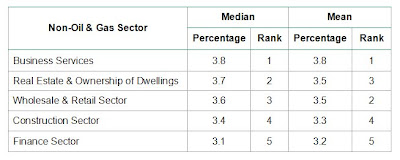
Well, actually, the above list is the top 5 growing sectors after oil and gas. Noted from the Brunei Economic Statistical Yearbook of the Department of Economic and Planning Department used by the International Monetary Fund, these 5 sectors had an annual nominal GDP growth rate of around 3% (on average) between year 2000 & 2005.
Following those statistics, the table below shows the nominal GDP growth percentage of these sectors over the five years.
While the top 4 has it's own interesting stories, the finance sector is the one that interests me. The many different marketing approaches & adverts that banks in Brunei put up in newspapers etc., in my opinion, are signs that the banks are getting increasingly competitive. Here are my reasons why I believe this is the case.
1. Relatively high Gross National Income (GNI) & Gross Domestic Product (GDP) Stats:
The WorldBank Development Indicators puts Brunei in the 'High Income' category based on 2004 Gross National Income (GNI) statistics. Combine that with the 2006 per capita GDP, estimated at around B$49,000 (See the 2006 Key Indicators) which is roughly at US$30,000, these two stats generally indicate Brunei as a relatively well-off country with Bruneians in general, able to purchase more goods & services than some other countries. That must be good for the economy, right?
2. Regulations on personel lending:
Year 2005 saw the Ministry of Finance's (MOF) intention to curb back on personal loans (to a maximum of 12 times the monthly salary), which is not surprising considering the amount of loans that goes bad which according to the International Monetary Board is somewhat high (See para 3). So if there are fewer personal loans than in the past, how can banks make more money?
3. Investment opportunities on the rise:
The issuance of short-term MOF Sukuk, Brunei Liquidified Natural Gas Sukuk and Baraka Investment Deposits are clear initiatives to get Bruneians to investment in Shariah-complaint funds. Financial counselling and consultancy has also been highlighted in some banks to get Bruneians to consider saving and investing in their banks.
Overall, these three points means that banks in Brunei will have to be more competitive and fight it out to get customers.
What does this mean for the average bank customer? In my opinion, this means that Brunei bank customers must ask some interesting questions to the bankers, not just because it's important to know what happens to our money but more important that we are clear on what the costs and other terms & conditions are. This is critical because once we've put our money in the bank, the costs to withdraw/cancel/change may turn out to be very costly.
So the next time we go to the bank to ask about that new product, let's ask some interesting questions. What have we got to lose?
Following those statistics, the table below shows the nominal GDP growth percentage of these sectors over the five years.

While the top 4 has it's own interesting stories, the finance sector is the one that interests me. The many different marketing approaches & adverts that banks in Brunei put up in newspapers etc., in my opinion, are signs that the banks are getting increasingly competitive. Here are my reasons why I believe this is the case.
1. Relatively high Gross National Income (GNI) & Gross Domestic Product (GDP) Stats:
The WorldBank Development Indicators puts Brunei in the 'High Income' category based on 2004 Gross National Income (GNI) statistics. Combine that with the 2006 per capita GDP, estimated at around B$49,000 (See the 2006 Key Indicators) which is roughly at US$30,000, these two stats generally indicate Brunei as a relatively well-off country with Bruneians in general, able to purchase more goods & services than some other countries. That must be good for the economy, right?
2. Regulations on personel lending:
Year 2005 saw the Ministry of Finance's (MOF) intention to curb back on personal loans (to a maximum of 12 times the monthly salary), which is not surprising considering the amount of loans that goes bad which according to the International Monetary Board is somewhat high (See para 3). So if there are fewer personal loans than in the past, how can banks make more money?
3. Investment opportunities on the rise:
The issuance of short-term MOF Sukuk, Brunei Liquidified Natural Gas Sukuk and Baraka Investment Deposits are clear initiatives to get Bruneians to investment in Shariah-complaint funds. Financial counselling and consultancy has also been highlighted in some banks to get Bruneians to consider saving and investing in their banks.
Overall, these three points means that banks in Brunei will have to be more competitive and fight it out to get customers.
What does this mean for the average bank customer? In my opinion, this means that Brunei bank customers must ask some interesting questions to the bankers, not just because it's important to know what happens to our money but more important that we are clear on what the costs and other terms & conditions are. This is critical because once we've put our money in the bank, the costs to withdraw/cancel/change may turn out to be very costly.
So the next time we go to the bank to ask about that new product, let's ask some interesting questions. What have we got to lose?

